

By Gosia Kwiatkowska, Director, Rix Inclusive Research Institute, University of East London

For many families, one of the biggest questions after school is whether their young person will still have real chances to learn, grow, and be part of their preferred community. Lifelong learning matters for every adult, including people with learning disabilities; it provides opportunities to explore ideas, build confidence and stay connected to others.
Equally important is who gets recognised as a teacher. Learning disabled adults bring knowledge shaped by their own lived experience. When they’re invited to step forward as co‑trainers and role models, they can challenge assumptions about what counts as expertise and strengthen the learning of everyone involved. Inclusive education must commit to both: meaningful opportunities to keep learning, and meaningful recognition of the people whose insights lead that learning.
The article below, by Rix’s director, Gosia Kwiatkowska, explores how these principles come to life through the RIX Big Ideas course—and it’s open to new applicants now. You can find more information at the end of the article.
A right to lifelong learning for everyone. By Gosia Kwiatkowska, Director, Rix Inclusive Research Institute, University of East London
For parents thinking about their son or daughter’s future, opportunities for continued learning are important. Education can offer space to explore interests, develop ideas, build relationships and take a fuller part in society. These opportunities should also be extended to people with learning disabilities throughout their lives.
At a time of debate about SEND funding and reform in England, we need to ask what education policy is seeking to achieve. Financial sustainability matters, but it must be considered alongside people’s rights, the quality of support and the opportunities available to them. Proposed reforms should be judged by whether they strengthen meaningful access to education. Cuts to SEND provision risk narrowing opportunities when they reduce the support people need to participate. Calling a system “inclusive” means little if learners cannot access teaching, communicate their views or obtain the help they need. Inclusion requires investment, accountability and the involvement of disabled people and families in decisions.
The right to keep learning
The UN Convention on the Rights of Persons with Disabilities recognises the right to inclusive education and lifelong learning. Article 24 specifically includes access to higher education, vocational training and adult education on an equal basis with others, with appropriate adjustments. This is a commitment to removing discrimination and barriers to participation. The UN Sustainable Development Goals (SDGs) reinforce this ambition. Goal 4 calls for inclusive, quality education and lifelong learning for everyone. Its targets include equal access to university and other further learning, and the removal of inequalities affecting disabled learners.
For families, these commitments raise a practical question: what meaningful learning opportunities will be available when school ends?
Employment and independent living are important, but education also has value in its own right. People should have opportunities to explore history, debate ideas, understand their rights and develop their own views. We should resist low expectations that limit what adults with learning disabilities are invited to learn.
Putting these principles into practice
The RIX Big Ideas course at the University of East London brings adults with learning disabilities and social work students together as fellow learners. They explore power, inequality, voice and the history of disability and exclusion. We use Easy Read resources, visual presentations and clear session structures. Multimedia approaches allow learners to communicate their understanding through images, video, audio and text. The aim is to make challenging ideas accessible while preserving their meaning.
I discuss our approach further in The RIX Big Ideas Course: rethinking learning for people with learning disabilities, published in Learning Disability Today.
Sharing knowledge and power
It is important to us that people with learning disabilities help shape and co-deliver the course because their expertise belongs in university teaching. Their experiences can deepen discussions about choice, rights and professional practice. A conversation about power might begin with who decides where someone lives, how support is organised or whose preferences guide everyday decisions. Connecting these experiences with wider ideas creates opportunities to question arrangements that may otherwise be taken for granted.
For social work students, learning alongside people with learning disabilities encourages listening and reflection on professional authority. For co-educators, it creates a recognised role in shaping other people’s learning.
One course cannot resolve the inequalities within education. It can, however, demonstrate what becomes possible when universities make space for different forms of knowledge and participation. Our ambition should be to build sustained opportunities like these into education policy and practice.
Joining the next course
The course is free for adults aged 18 and over with learning disabilities, and there are no other entry requirements. Everyone who completes it receives a University of East London certificate.
The next course begins on 4 November 2026, with sessions from 11am to 1pm. Places are limited and offered on a first-come, first-served basis.
You can find more information here. To register your interest, please email rixadmin@uel.ac.uk. If demand exceeds available places, we will explore an online option for those unable to attend face-to-face.
Disabled Children’s Rights are Under Attack.
We’re fighting, but we can’t do it alone: we need your help more than ever.
We’re volunteer-run, but costs are rising. To help us keep going, please consider a one-off or, if it’s possible, a regular donation.
Read more about being a regular donor here.
We use Zeffy to fundraise, which doesn’t charge us a fee, so 100% of your donation reaches us.

Key Content


Also read:
- Four real risks posed by plans to move away from child-centred SEND principles, towards NHS-style commissioning

- Early 2027 for Education and SEND Bill but how far will the Government row back on rights plans? Parental trust and confidence depend on it
- Locked out of holiday fun: SEND reform must tackle the provision gap for disabled children in care
- Training new teachers to arrive skilled, confident, and ready to support their pupils with SEND
- “We don’t see that here”: How teachers can better navigate a parent’s different view—and why pupil voice and professional curiosity are vital
- The AI-generated Local SEND Reform Plans that will dictate local SEND provision and their huge hidden risks even LAs can’t ignore
- The regional teams from Whole School SEND offering free SEND learning to school and college teaching staff
- Why ‘functioning’ might be the missing piece in the SEND reform puzzle
- The child behind the symptoms: Why MCAS is being missed in children and young people
- The government must not ignore stark warnings about lack of mainstream SEND capacity reported by its own research
- What makes an autism assessment report genuinely useful to a school?
- Big ideas belong to everyone: Education, rights and lifelong learning for people with learning disabilities




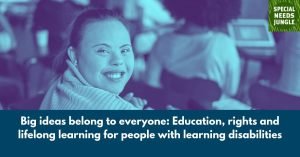
- Big ideas belong to everyone: Education, rights and lifelong learning for people with learning disabilities
- Research finds the Government’s SEND National Conversation “performative”, lacking pathways for young people’s inclusion
- Research: Disabled young people define inclusive education as “learning in the place that’s right for them”
- Mainstream SEND Funding: A simple explainer, another consultation, and why it really matters
- Autistic teenage campaigner Tee-Jay petitions Parliament to protect SEND Rights: Sign his petition!
- Capital carrot, SEND steamroller: The Government’s evidence-light reform route isn’t waiting for anyone
- Schools White Paper: What do we know so far about funding for SEND?
- SEND cash splash: What does it all add up to—and will ditching debt improve provision?
- Inclusion bases: a new label, a big ambition, same unanswered questions
- Fix SEND our way for 90% of SEND debt write off, Government tells councils, urging swift action on change. So much for co-production…
- EXCLUSIVE: LAs largely ignored Government’s “strong recommendation” on how to spend SEND Capital cash
- At 13, Functional Neurological Disorder changed my life forever—my EHCP’s therapy activities helped me get back outside
- The £3 billion SEND funding extravaganza: We’ve crunched the numbers so you can ask the right questions
- #SpecialistFEWorksforMe: Help celebrate the importance of specialist further education!
- SEND funding reforms will be immensely painful—but the current situation is chaotic and sinking fast


Don’t miss a thing!
Don’t miss any posts from SNJ – simply add your email address below. You must click the link in the confirmation email you’ll receive to activate your free subscription.
You can also keep up with us by following our
Want more? Be an SNJ regular donor!
SNJ is a non-profit and everyone who writes here does so voluntarily. We need your support to help us with costs by donating once or as a regular patron. Find out more here

- Training new teachers to arrive skilled, confident, and ready to support their pupils with SEND - October 30, 2026
- “We don’t see that here”: How teachers can better navigate a parent’s different view—and why pupil voice and professional curiosity are vital - October 28, 2026
- The regional teams from Whole School SEND offering free SEND learning to school and college teaching staff - October 23, 2026
Please share this article!

Discover more from Special Needs Jungle
Subscribe to get the latest posts sent to your email.
