

With Lynette Barrett, CEO National Star and Chair of Natspec

One of the biggest worries for parents is what will happen when their disabled child leaves education. That’s not just a worry for those whose young people have an EHCP — we recently met a mum and her young adult autistic son, who had been educated in mainstream and turned down for an EHCP, though clearly needed one. He missed out on any options for supported internships or specialised support, and we know he’s far from alone. Those with EHCPs often don’t fare a whole lot better, whether they have complex disabilities, or if they are able enough to get to university.
But what doesn’t exist, is much data about what does happen to young people with SEND after education. The Together Trust is working with post-16 specialist college, National Star on some research to better understand this. Lynette Barrett, CEO of National Star and Chair of Natspec, has written for SNJ more about the research and how you can help…
Help us learn what happens to young adults with disabilities after education. By Lynette Barrett, CEO of National Star
Young people with complex disabilities and their families face countless challenges as they move into adulthood and look to transition out of the education system, into adult services. Transitioning into adult services is often described as a difficult and confusing process, made more challenging by the disparities between each local authority, social care and health commissioners. Young people are left to navigate a complicated system, which differs between local authorities across the UK.
Sadly, there are countless news stories about transitions that have gone wrong. They are heart-breaking accounts of young people who have made great strides in their development and independence during education but then lose those skills because they do not have the opportunities to put them into practice. It’s a recurring theme that we hear at National Star. One parent recounted she was told by her MP that as long as her daughter was “safe” then “meaningful activity was a luxury”. Surely, it’s a basic human right that every person, regardless of disability, should have a meaningful life, feel valued, be an active member of society, and be able to participate in activities that bring fulfilment and joy. However, we also know of successful transitions, where the person has flourished in adulthood and has benefited from good support and opportunities.
Who is the survey for?
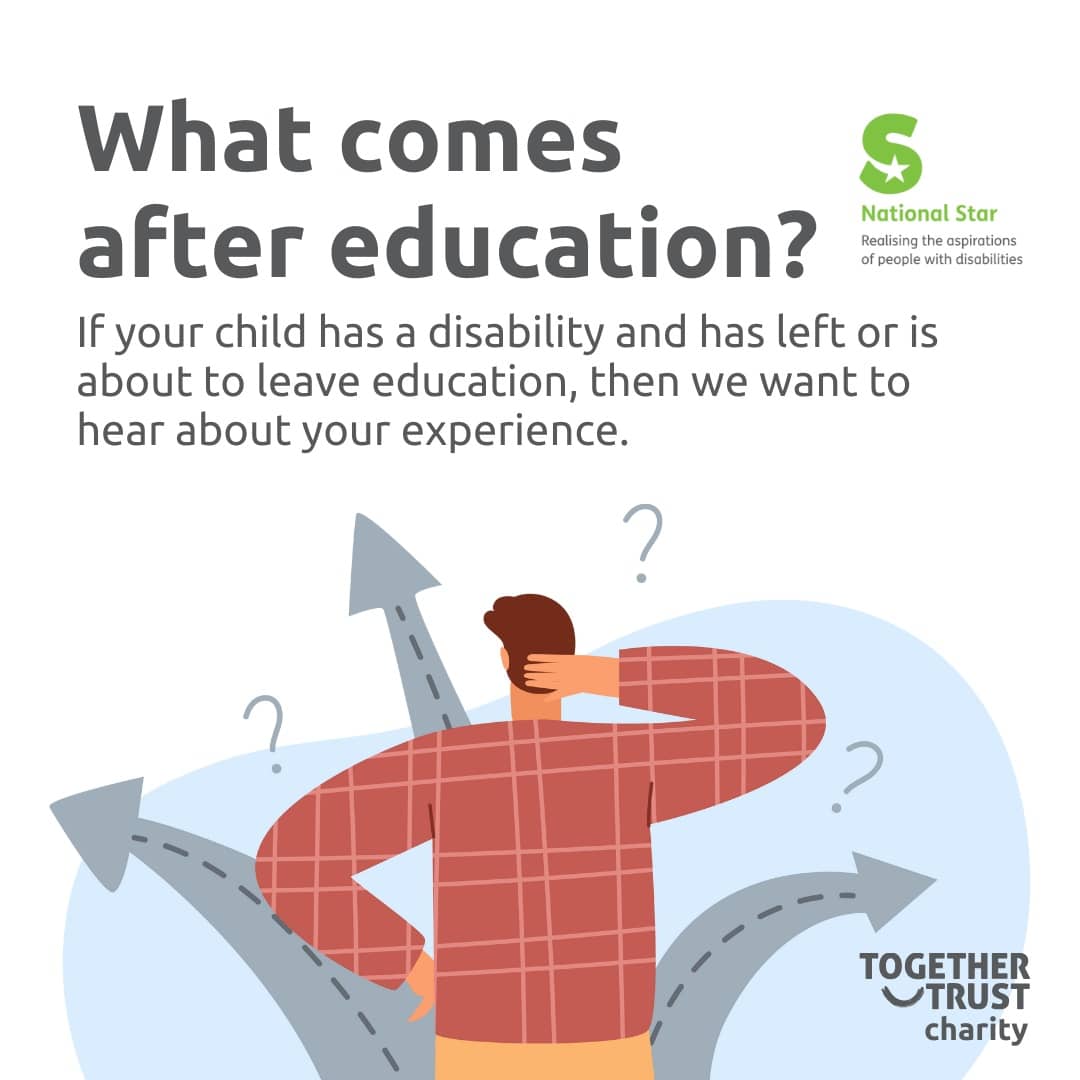
To raise awareness of the challenges faced by young people and those who care for them, National Star is working in partnership with another charity, the Together Trust, to carry out research. The project aims to inform how we can improve the process and opportunities for young people as they transition from education.
We have created two surveys to collect information about what happens after education. One is for families and carers, and one is for young people. The survey is for anyone who has left or is about to leave education, to help us understand their journeys and highlight the transitions that have worked well and why, and the consequences of when they go wrong.
It doesn’t matter if the young person left school at 18 or went on to further education, attended mainstream education or specialist education. They may have left education five years ago or they may be finishing this year. We want to capture all your journeys so that we can present a comprehensive piece of research to the Government.

Creative solutions that work well
There are stories of families finding creative and unique solutions. One covered in the media was the experience of Peter and Sally Lawrence, who were desperate for their son, Simon, to live in their home area, yet share a home with his peers. Their solution was the creation of the Simon Trust. They found a perfect site to accommodate 10 young autistic adults and convinced Surrey County Council to buy it. Linden Farm is a purpose-built development for adults with severe autism and complex needs. The family worked for years on the project, proving to the local authority it was a sound financial option. It’s an amazing example of what can be achieved when LAs and families work together and focus on the best interest of the young person.
John Harris, a columnist with The Guardian and a parent of a child with an EHCP wrote an incredibly moving piece about how politicians are blaming parents for the SEND policy failures within the country, something SNJ has covered extensively. The government has acknowledged the failures around the implementation of the Children and Families Act and work has begun on the SEND Improvement Plan, yet we still hear senior politicians claiming local authorities struggle to distinguish between “deserving” families and “those with the loudest voices, or the deepest pockets, or the most persistent lawyers”.
Take the survey
National Star believes young people with SEND should have the right to a good quality of life, not merely existing and the freedom to choose the support that best meets their needs. That’s why we appeal to families to take a few minutes to complete our survey. The survey will run until 31 March 2024. Findings will be shared with the government to help inform new SEND standards.
The survey for young people is designed to be user-friendly, allowing responses in both written and verbal formats. You can access it here
You can find the survey for families and carers here.
Thank you for your time and support of this important research and please share it with any support groups you belong to. The more responses we receive the stronger our message can be to government officials and policy makers.
Also read:
- SEND Improvement: Supported internships without EHCPs, plus “incredible”, “unforgettable” disabled children’s short breaks
- Why Preparing for Adulthood outcomes, from the earliest years, must be an integral part of the new national EHCP template.
- How H&M and WorkFit helped my daughter who has Down syndrome gain purposeful, paid experience of work
- Research finds unfounded FII accusations cause “devastating and often life-long impact on children and families” and over 80% of allegations dropped
- Miracles and magic: Delivering Better Value in SEND. But better value for whom?
- How well is the Government respecting children with SEND’s right to education?
- Uncovering the origin of the evil EHCP ‘Golden Ticket’ Narrative
- The Government’s SEND Improvement Plan: an initial overview
- Supported Internships opening doors to employment for young people with SEND
Don’t miss a thing!
Don’t miss any posts from SNJ – simply add your email address below. You must click the link in the confirmation email you’ll receive to activate your free subscription.
You can also keep up with us by following our
Want more? Be an SNJ regular donor!
SNJ is a non-profit and everyone who writes here does so voluntarily. We need your support to help us with costs by donating once or as a regular patron. Find out more here

- Let’s scrutinise it: Why ministers should publish a draft SEND Bill now to enable Pre-Legislative Scrutiny - November 17, 2026
- What is the cost of an EHCP that isn’t delivered? And who’s responsible for checking it is? - November 13, 2026
- Book Review: Flush Forward! Rethinking Toileting for Disabled and Neurodivergent Young People - November 11, 2026
Please share this article!

Discover more from Special Needs Jungle
Subscribe to get the latest posts sent to your email.

Just discovered the podcasts, my only way to access alot of information re SEN as a parent. A good way to absorb info whilst tackling daily tasks.