

If you’ve been tracking the government’s reform announcements since Labour came to power, you may have noticed similar language being used more frequently across various different public‑sector changes. Documents are frequently scattered with “place-based” language to describe new or proposed approaches to delivering health or care provision.
Place-based language is not new—the previous Labour government was also a fan—but it feels like it’s once again becoming central to proposed reform of public sector services.
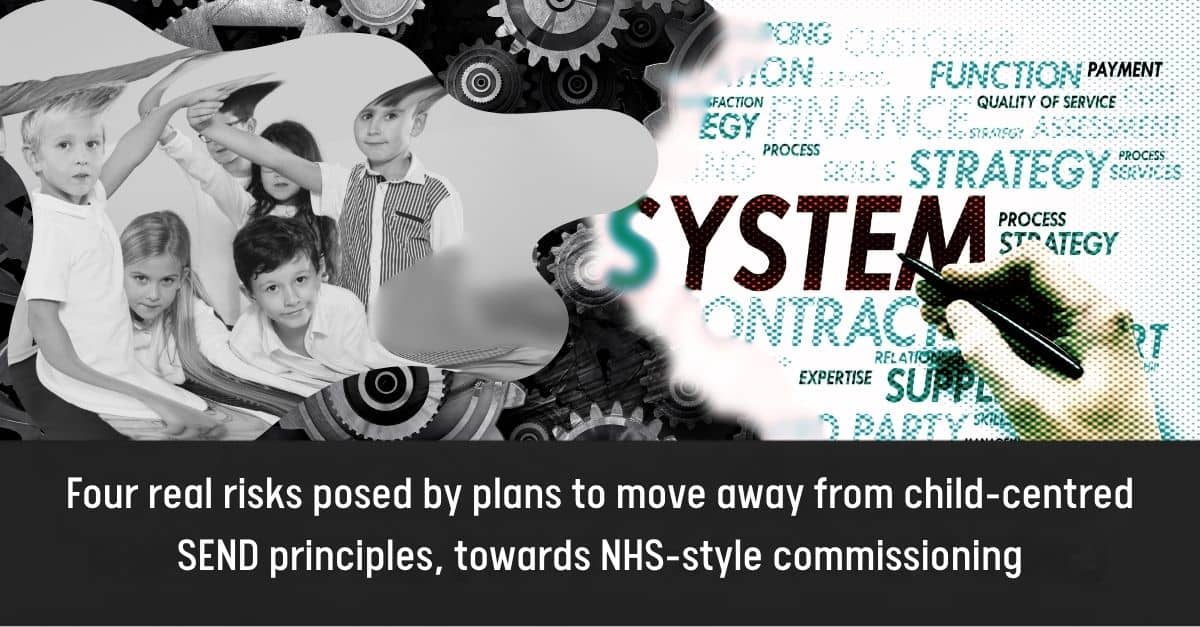
This shift to place-based approaches can now also be seen within the proposed SEND reforms. For example, the proposed Specialist Provision Packages (SPPs) are being designed to support area‑level commissioning arrangements, with specific schools being commissioned by local authorities to deliver particular provision packages. Although the ‘packages’ are not being formally described as ‘pathways’ I have heard professionals likening them to pathways for specific groups of children, which led me to think about them in relation to clinical pathways and how these pathways are commissioned in health provision. And there are some similarities between the two.
SPPs: population level commissioning
If the architecture of the SEND system is being rebuilt around population‑level commissioning approaches, as seen in the NHS, and as proposed with the new SPPs, this is inconsistent with the maintenance of individual legal entitlements for pupils with SEND. (Read here for more information on the rights SNJ has already identified as being at risk).
The NHS population‑health model is built around neighbourhood footprints, multidisciplinary teams, integrated providers, upstream prevention, and shared accountability. The SEND consultation showed Experts at Hand teams, inclusion bases, universal and group‑based support, and shared accountability emerging from joint LA–ICB commissioning footprints. This suggests a similar architecture, just with different acronyms. Of course, this is not inherently bad. It is possible that aligning health and education footprints could finally solve some of the problems families continue to face, for example, in securing speech and language (SaLT) or occupational therapy (OT) provision.
However, the current SEND system is not built on a population‑based commissioning model as seen in the delivery of healthcare. It’s based on an assessment of individual needs with legal rights to provision that meets those assessed needs.
In the NHS, a patient only receives access to a service if they meet the pre-defined clinical criteria for a commissioned pathway or intervention and where the service has the capacity (staffing, budget, slots) to deliver it. There is no individual legal entitlement that forces the NHS to provide a specific therapy, amount of provision, or timeline. There is no SEND tribunal equivalent if you disagree with a decision that has been made within the NHS.
“…within the proposals lies a fundamental shift in how provision and eligibility will be determined.”
Introducing place-based provision
The Local SEND Reform Plan guidance document from the DfE is full of language that sounds positive: for example joined‑up, place‑based, multidisciplinary, early intervention, universal offers. Families are likely to welcome all of this, having navigated a system where different parts find it difficult to talk to each other. But within the proposals lies a fundamental shift in how provision and eligibility will be determined.
The document explicitly frames SEND delivery as “joined‑up, place‑based provision”.
It repeatedly emphasises the need for local areas to introduce:
- universal offers
- group‑based support
- pooled resources
- shared governance
- locality footprints
Its aim is to have reduced reliance on individualised provision; something families will definitely not be so keen on. This guidance document introduces language frequently seen in population‑health commissioning.
What is important to note is that once provision is commissioned at population level, individual legal entitlements become constrained by what the system has already purchased. The question subtly shifts from: “What does this child need?” to “Which package does this child fit?”
Specialist Provision Packages: clinical pathways in SEND clothing
The SEND consultation that closed earlier this year made the commissioning logic explicit:
“Settings will be commissioned to provide placements for specific Specialist Provision Packages, and they will organise support for the whole group of children assigned to that Package.”
That is the exact commissioning logic we see within NHS clinical pathways. Clinical pathways are designed at a high level, providers are commissioned to deliver a standardised offer, and patients are allocated to specific healthcare pathways if they meet the criteria. SPPs are the education equivalent.
The consultation also stated “The local authority (LA) will create an Education, Health and Care Plan (EHCP) for each child, choosing the parts of the Specialist Provision Package that are relevant to their needs.”
This is a clear and explicit shift away from bespoke individual provision following assessment, to a pre‑defined menu of options available. This shift in organising provision for children with SEND completely flips the current legal model on its head. You can read more about this apparent change in thinking about provision in my article here.
Currently, the EHC needs assessment drives provision, which is set out in the EHCP. Under the proposed reforms, the commissioned package drives provision, and the EHCP describes what package has been agreed. The day to day detail is agreed with the setting and is detailed within the new Individual Support Plan (ISP).
Finally the consultation document described how“the provision detailed within each EHCP must be delivered by the setting in line with their funding arrangements with the LA.” This is also important to note, because this clearly articulates how the funding arrangement is what determines what the setting can actually deliver for its cohort. Again, this has parallels to Health, where eligibility is also determined by what capacity services have to deliver.
The risks of a clinical pathway approach being imported into SEND provision
Clinical pathways come with well‑documented risks. What happens when you transplant those risks into a system which is currently based on individual legal entitlements?
- Prioritising the “average” child or young person
One major risk is that such pathways tend to prioritise the “average” case. They may work well for the majority, but they can fail children with atypical, complex, or overlapping needs. This is, of course, the very cohort that SPPs are currently being designed for, the children and young people with the most “complex” needs (recognising that there still has been no definition of “complex”). A child with a more complex profile of needs may be forced into the wrong package (or packages) or may be completely denied any additional bespoke provision that they need because “the package” is all that is offered. This is a significant shift from the current legal requirement for individualised, specified, quantified provision following individual assessment.
- System rigidity
Pathways are meant to be guides, but what happens in practice is that they often become rules. They are followed because they’re safe, sanctioned and administratively convenient. SPPs are likely to be treated as the offer, all that is available. Panels may refuse provision outside the package because it’s “non‑standard.”
- Centralised decision making
Pathways shift power from individuals to systems. Decision‑making often becomes centralised in ‘expert’ panels and protocols. It is clear that families will have less influence when provision is determined by standardised packages and multi‑agency decision‑making. It is unclear what role person-centred planning might play.
- Further entrenching inequity
Clinical pathways can inadvertently entrench inequity. Children who face multiple disadvantages, are more likely to be miscategorised or under-served. For example, children from minoritised communities may be placed into the wrong package due to bias in identification. The shift to a place-based approach risks widening the very inequalities the reforms claim to address.
Safeguarding individual rights amid systemic and structural reform
It looks as though the government is trying to quietly rebuild the current rights‑based SEND system into a new approach based on population‑health logic. This has the potential to have significant consequences.
Any system built on pre-determined and pre‑purchased “packages” inevitably shifts planning away from the needs of the individual child or young person and towards the needs of the system. Once provision is commissioned in bulk, as is proposed via the (currently) seven packages, to be determined by the panel of national ‘experts’, the requirement will be towards fitting the child to the packages that are available. A child-centred approach is at the very heart of the existing Children and Families Act—and for good reasons. This is a significant structural re‑engineering of the existing SEND framework.
If the underlying machinery of the SEND system is population‑based, then the legal promise of individualised, specified, quantified provision becomes even harder to realise in practice than it currently is. This funamental shift is not being made explicit by Ministers and the DfE.
Once rights are diluted by system design, they will be far harder to reclaim. Put together with the “functioning” approach we are now convinced is also underpinning these reforms, this is something that needs much more open discussion, clarity, and honesty before any Bill is forthcoming. Our children deserve it.

Disabled Children’s Rights are Under Attack.
We’re fighting, but we can’t do it alone: we need your help more than ever.
We’re volunteer-run, but costs are rising. To help us keep going, please consider a one-off or, if it’s possible, a regular donation.
Read more about being a regular donor here.
We use Zeffy to fundraise, which doesn’t charge us a fee, so 100% of your donation reaches us.

Key Content


Also read:
- Can’t attend ≠ won’t educate: Draft guidance blames parents for “educational neglect” if LA decides the home education isn’t “suitable”

- Research: Does every child really get a fair chance? The “identity lottery” at the intersection of race and SEND, and how the Schools White Paper got it so wrong
- What would you ask in the petition debate when SEND rights returns to Parliament:
- School exclusion and the SEND proposals: Last chance to respond to the Government’s Call for Evidence on reforming exclusions
- Let’s scrutinise it: Why ministers should publish a draft SEND Bill now to enable Pre-Legislative Scrutiny
- What is the cost of an EHCP that isn’t delivered? And who’s responsible for checking it is?
- Book Review: Flush Forward! Rethinking Toileting for Disabled and Neurodivergent Young People
- Four real risks posed by plans to move away from child-centred SEND principles, towards NHS-style commissioning
- Early 2027 for Education and SEND Bill but how far will the Government row back on rights plans? Parental trust and confidence depend on it
- Locked out of holiday fun: SEND reform must tackle the provision gap for disabled children in care
- Training new teachers to arrive skilled, confident, and ready to support their pupils with SEND
- “We don’t see that here”: How teachers can better navigate a parent’s different view—and why pupil voice and professional curiosity are vital



- Four real risks posed by plans to move away from child-centred SEND principles, towards NHS-style commissioning
- Why ‘functioning’ might be the missing piece in the SEND reform puzzle
- The child behind the symptoms: Why MCAS is being missed in children and young people
- Research: SEND case officers are LAs’ “human shield” gatekeepers. But parents shouldn’t have to be their own key workers
- EOTAS: Why the Government must listen to those with lived experience
- Beyond EHCPs: Why Inclusion Needs More Than a Document
- Unison voices major concerns over SEND reform health plans for sick and disabled children out of school in the EOTAS consultation
- Why every child deserves Portage, wherever they’re born
- Allergy Guidance issued—but wider medical conditions guidance back for more work
- ARFID: Avoidant/Restrictive Food Intake Disorder is much more than just “fussy eating”
- Draft medical conditions guidance raises “serious concerns” says union, over shift in clinical responsibilities to schools
- When hope has been drained, families struggle to trust promises to fix SEND
- Consultation: Supporting pupils with medical conditions at school. What’s new, what’s missing and what you need to know
- When “Easy Read” isn’t easy: Why the SEND consultation risks excluding disabled children and young people
- “We are living on a knife-edge” SENDCo research sounds the alarm about the high cost of mainstream inclusion


Don’t miss a thing!
Don’t miss any posts from SNJ – simply add your email address below. You must click the link in the confirmation email you’ll receive to activate your free subscription.
You can also keep up with us by following our
Want more? Be an SNJ regular donor!
SNJ is a non-profit and everyone who writes here does so voluntarily. We need your support to help us with costs by donating once or as a regular patron. Find out more here

- Four real risks posed by plans to move away from child-centred SEND principles, towards NHS-style commissioning - November 9, 2026
- Why ‘functioning’ might be the missing piece in the SEND reform puzzle - October 21, 2026
- Research: SEND case officers are LAs’ “human shield” gatekeepers. But parents shouldn’t have to be their own key workers - September 22, 2026
Please share this article!

Discover more from Special Needs Jungle
Subscribe to get the latest posts sent to your email.
