

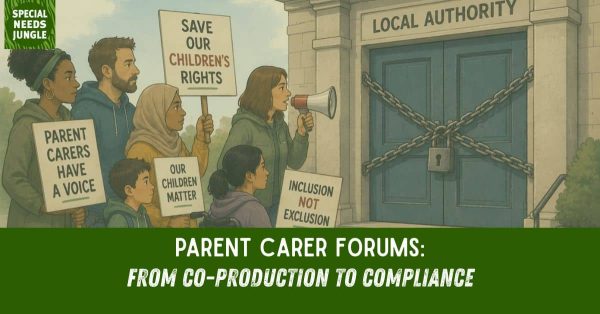
Many of us in the Special Needs Jungle community have been involved in Department for Education (DfE)-funded Parent Carer Forums (PCFs) at some point in our journey as parent carers. Some of us still are.
While PCFs are often criticised for accepting DfE funding, and therefore, some argue, being constrained by it, it is important to remember who actually keeps these forums running. They are SEND parents. Parents giving up evenings, weekends and scarce emotional energy to sit in meetings, challenge decisions, and try to improve things for the families coming behind them.
That’s why new guidance issued to PCFs by Contact, the national charity commissioned to administer PCF funding and support forums, has landed with such alarm. This guidance doesn’t simply read as further clarification about how forums themselves should operate. It appears to go much further, dictating how parent carers involved with their PCFs are allowed to speak out and campaign in their personal lives.
This doesn’t read like guidance. It reads like a warning shot to anyone with a role within a PCF that any signs of dissent against the proposed SEND reforms will be silenced. Contact, self declared as being “for disabled children and their families” are using their power and control to force PCFs to silence the very families with disabled children that they are apparently so keen to speak for.
Not only does this directly go against the very reason that PCFs came about in the first place, it also suggests that parents who have spent many years fighting for their disabled children through refusals, delays, unlawful decisions and exhausting battles for support can suddenly neatly separate that experience into “acceptable participation” and “unacceptable public advocacy”. This simply isn’t how the world works.
So what exactly are Parent Carer Forums, how did they come to occupy such an influential position within the SEND system, and why are so many people now worried that this guidance risks silencing the very voices these forums were created to amplify?
What exactly is a Parent Carer Forum?
If you are (un)lucky enough to find yourself knee deep in the SEND world, ‘Parent Carer Forum’ probably sounds like one of those slightly vague bits of public-sector infrastructure that everyone involved kinda understands and everyone outside it ignores. In reality, PCFs have become one of the most influential, and politically useful, parts of the SEND landscape in England.
There is now a Parent Carer Forum in almost every local authority area. Most are small charities or community interest companies made up of parents and carers of disabled children and young people. Their role is to bring families’ lived experience into the design and delivery of education, health and social care services, or in policy speak, their roles are that of ‘participation’ and ‘co-production’ when shaping services. The idea is simple enough- services work better when the people using them help shape them.
And to be fair, there is truth in that. Many PCFs have achieved genuinely important things locally: improving communication between families and services, influencing local policies, highlighting gaps in provision, and making sure decision-makers hear things they might otherwise prefer not to.
So how did a movement built on parent advocacy arrive at a point where campaigning parents are increasingly being viewed as a problem?
To answer that question, we need to understand how PCFs came about. Spoiler alert: PCFs did not emerge because government suddenly became enthusiastic about sharing power with parents.
How the internet changed everything
To understand the rise of PCFs, you have to go back to the late 2000s and the old SEND ‘statementing’ system. A system many families experienced as exhausting, inconsistent and adversarial (sound familiar?!). Parents across the country were fighting remarkably similar battles with delayed assessments, unlawful refusals, inaccessible schools and fragmented health and social care support that they are today. And then something important happened. Parents started finding each other online.
The widening social web brought Yahoo groups, condition-specific message boards and, in 2008, both the first forums and the start of Special Needs Jungle. By 2010, other SEN blogs and the first wave of Facebook groups arrived. Together, they allowed families to compare experiences in a way that had never before been possible. What many had assumed were isolated local problems suddenly looked a lot more systemic. Different postcode, same story.
That shift in understanding kindled the flames of collective knowledge and shared goals. Once parents realised it wasn’t ‘just them’, individual frustration became collective challenge. Families began sharing legal knowledge, tribunal strategies, policy information and survival tactics. Parents who had never met in person started identifying patterns in how local authorities operated.
In other words, parent carers became organised, and, although nobody was naming it at the time, much of that activity looked an awful lot like campaigning.
From grassroots challenge to government-funded participation
By the late 2000s, government could no longer really pretend that dissatisfaction with the SEND system was coming from a handful of ‘sharp-elbowed parents’. Families were becoming increasingly organised, increasingly informed, and increasingly public about what they were experiencing. The rise of online communities had changed things dramatically. Parents who might once have struggled alone were now comparing experiences nationally and discovering that the same patterns kept emerging: delayed support, unlawful decisions, inaccessible schools and exhausting battles for basic provision.
At the same time, criticism of the SEND system was growing politically. Reports and reviews were raising concerns about fragmented services and adversarial relationships with families, while parents themselves were becoming more visible in the conversation around disability rights and education.
Programmes such as the Aiming High for Disabled Children programme began promoting ‘parent participation’ as a formal part of improving services. Funding was introduced for participation projects and, over time, Parent Carer Forums became established across England. By the time of the Children and Families Act in 2014, ‘co-production’ had become embedded in SEND policy itself. Some PCFs, Surrey for example, were started specifically to be part of these reforms.
To be fair, much of that was positive. Parents absolutely should be involved in shaping services. Many forums have done genuinely important local work. But bringing parent challenge into formal structures inevitably changed its nature too. Because once participation becomes funded, structured, and dependent on maintaining relationships with local authorities, NHS bodies and government, tensions emerge. Parent Carer Forums were supposed to balance those tensions by becoming what policy people like to call ‘critical friends’: collaborative enough to stay in the room, independent enough to challenge what was happening when outside it.
However things start to get difficult when the ‘critical’ part starts becoming “inconvenient”.
The compromise at the heart of co-production
As Parent Carer Forums became more established, something else happened too. They became increasingly woven into the machinery of the SEND system itself. What had begun as grassroots parent-organising, evolved into a nationally-funded participation network, the NNPCF. Forums gained recognition, access to decision-makers and, in some cases, real influence. Parents who had once struggled to get anyone to listen were now sitting on strategic boards, shaping local policy and feeding directly into national discussions.
Funding for particiption comes with an implicit compromise. For a seat at the table, PCFs were expected to leave the placards at the door. From the beginning, forums were told that Department for Education funding could not be used for campaigning or lobbying. That distinction broadly made sense and, for years, most forums navigated it without too much difficulty. Acting as a PCF was understood to be different from acting as a parent.
A parent could spend one afternoon in a co-production meeting discussing local SEND transport policy, and the next weekend protesting cuts to children’s services. Nobody seriously struggled to understand the difference. At least, not until now.
Shifting boundaries
Over time, the boundaries around participation appear to have tightened. As forums have become more formalised, the expectations placed upon them have changed too. ‘Participation’ has increasingly come to mean not simply bringing parent experience into the room, but doing so in ways that were collaborative, constructive and non-adversarial.
That shift is important because SEND parents do not divide neatly into ‘participants’ and ‘campaigners’. The same people doing co-production work are often those same people publicly challenging unlawful decisions, speaking to the media, organising support groups, helping families at the SEND Tribunal and campaigning for change. After all, you do not spend years fighting for your disabled child and then suddenly become politically neutral because you joined a strategic board.
Contact has also become increasingly central to the infrastructure around Parent Carer Forums. This has not been a sudden takeover. Contact (then Contact a Family) had been involved in supporting parent participation since the early years of the programme, alongside Department for Education funding designed to expand PCFs nationally. But over time, that support role evolved into something much more influential.
In regard to PCFs, Contact now operates almost like a quango. It administers the Parent Carer Participation Grant programme on behalf of the DfE, provides advisers to forums, oversees guidance and governance processes, offers training to forums and plays a major role in shaping how forums understand both their responsibilities and their limits. And that creates an interesting tension.
Because Contact is itself a national campaigning charity, it can publicly challenge government policy, support national campaigns and lobby ministers in ways that individual Parent Carer Forums, tied to DfE participation funding, increasingly cannot.
In other words, the organisation responsible for supporting Parent Carer Forums remains free to publicly campaign on behalf of disabled children and families, while the forums themselves are increasingly being reminded of the importance of neutrality, reputation and maintaining trust with system partners.
And that brings us to the new guidance.
The shrinking space for parent advocacy
At first glance, the new guidance does not appear especially dramatic. Much of it repeats familiar principles: Parent Carer Forums should not use Department for Education funding for campaigning or lobbying, and should avoid presenting political activity as being carried out in the name of the forum itself.
Few people seriously dispute that. But buried further down is wording that has caused growing alarm within many forums. The guidance states that those responsible for running or representing a PCF should be “precluded” from holding leadership or representative roles in campaign groups, or from undertaking “public-facing campaigning or lobbying activity”.
“While parent carers can be a member of both their PCF and a campaign group, and PCFs and campaign groups may choose to work together collaboratively to achieve change in their area, it’s important for PCFs to have strong governance in place around the leadership and running of the PCF, including a very clear conflict of interest policy. This would preclude those responsible for running the PCF (steering group members / trustees / directors) and those representing the PCF also having a leadership or representative role in a campaign group or undertaking any public-facing campaigning or lobbying activity. This helps to ensure the PCF can build trust with its partners, which is an essential part of its role. So while a leader or representative of a PCF could, for example, choose to sign a petition (in a personal capacity) set up by a campaigning group, they couldn’t give a media interview on behalf of the campaign group promoting that petition.”
Parent Carer Forums and campaigning or Lobbying Activity
And that is where the distinction between the forum and the parent starts to collapse.
What this means for parents in forums
This is no longer simply about whether a Parent Carer Forum can officially organise a protest or endorse a campaign using public money. It is about whether the parent carers involved in those forums are still considered suitable representatives if they are publicly visible challenging the system in their own time and in their own personal capacity.
That is a very different proposition and the implications are potentially enormous. Because if interpreted strictly, this guidance does not just affect a handful of outspoken activists. It cuts directly across the reality of how the SEND world actually functions.
Many of the people leading Parent Carer Forums are already deeply involved in public advocacy around disability rights and SEND policy. Some help run local campaign groups. Some are trustees of charities involved in national campaigns. Some speak publicly about unlawful practice or collapsing services because they have spent years witnessing those failures firsthand.
In many cases, those are precisely the people forums rely on most. The parents with the deepest understanding of the law. The strongest relationships with local families. The clearest grasp of how systems really operate, and that inevitably creates a serious question for the future of PCFs themselves. Because if visible public advocacy becomes incompatible with leadership or representative roles within forums, what happens next?
Who exactly is left?
Not just philosophically, but practically.
Parent Carer Forums are already heavily dependent on a relatively small number of highly experienced volunteers and a few paid staff members. Remove the people most willing to publicly challenge the system and forums do not emerge untouched. They become quieter. Safer. Less adversarial. Less politically difficult. And perhaps, from some perspectives, easier to manage.
Why now, and why this way?
This is the point at which many parent carers are starting to ask a much more uncomfortable question. Why is Contact, a charity whose public identity is built around supporting and amplifying the voices of families with disabled children, involved in producing guidance that warns parent carers against being too publicly vocal?
That question becomes even harder to avoid given the wider context. The guidance has emerged at exactly the same moment that anger within the SEND community is becoming increasingly visible. Thanks to our Save Our Children’s Rights Campaign parents are protesting proposed reforms to disabled children’s rights, publicly challenging the erosion of support, and organising nationally in ways not seen for years.
An inconvenient truth?
Some of the people involved in those campaigns are not outsiders to the PCF system. They are PCF reps, directors and volunteers. Parents who have spent years doing exactly what the system asked of them: engaging constructively, attending meetings, feeding back lived experience and trying to improve things through ‘co-production’. Which makes the timing feel difficult to ignore.
That’s particularly the case, because concerns are now being raised within the community about the extent to which highly visible parent campaigners connected to movements such as SOCR are coming under increased scrutiny because of their PCF involvement. Whether intentional or not, many parent carers are starting to feel that the more publicly critical you are of the SEND system, the less welcome you become within the structures supposedly designed to represent parent voice.
And it would be unfair to pretend this guidance exists in isolation.
Many parent carers would argue that tensions around visibility, criticism and ‘acceptable’ forms of engagement have been building for some time. The Department for Education has already faced criticism over the way it has engaged with families around the current proposed SEND reforms.
Parents have been sitting through the much-criticised ‘national conversations‘, where chat functions were tightly moderated and only selected questions appeared to make it through. Official DFE SEND reform propaganda announcements have repeatedly been met with such overwhelming criticism from families that comment sections have quickly been turned off on every single one of them.
Even the structure of the SEND consultation itself has drawn criticism for tightly controlling the terms of debate through pre-set questions while leaving little room to fundamentally challenge the direction of travel, with the DfE’s own lawyers admitting that some aspects of the reforms were already decided, before the so called ‘conversations’ had even begun. Their embarrasing backtracking on this didn’t fool anyone.
Putting together the pieces
None of this proves some coordinated attempt to silence parents. But taken together, they paint a picture of a system becoming increasingly uncomfortable with parent voices it cannot tightly manage. This will destroy the whole principle of co-production, which only works if parents feel able to speak honestly; not just inside carefully managed meetings, but publicly when necessary. Parent Carer Forums that cannot contain outspoken parents are not really representing the SEND community as it actually exists. They are representing the version of parent voice the system feels most comfortable hearing.
This contradiction is impossible to ignore. For years, parent carers were encouraged to become informed, organised and confident. They were told their lived experience was important. They were told to challenge poor practice, to hold systems to account. But now, as families become louder, more connected and more politically organised again, the same system seems increasingly unhappy at the fact that some of us took that invitation seriously.
The danger is not just in deterring outspoken parents. The danger is in the system beginning to treat outspoken parents as fundamentally incompatible with ‘good’ participation itself.
Can Parent Carer Forums survive this?
Undoubtedly, Contact’s new guidance puts Parent Carer Forums in an impossibly difficult position. Should they play nicely and do as they are told, but risk losing a large number of experienced and highly driven volunteers? Or should they put their PCFs funding at risk and push back on this deeply concerning direction that Contact is taking them in?
The fact that these parent carers, who voluntarily give up their time to try and improve services for other families that follow behind them, are being put in this position is reprehensible. When PCFs are already dealing with criticism and push back from families angry that they seem complicit in the reforms for the simple fact that most PCFs already feel unable to even openly criticise, then we must ask the question of whether Contact’s new guidance might spell the beginning of the end for PCFs.
Because this controversy is not unfolding in isolation. Parent Carer Forums are already facing enormous pressure from every direction. The SEND system itself is entering a period of profound instability and reform. Integrated Care Boards are being restructured. NHS England has effectively been dismantled into the Department of Health and Social Care. Local government faces further devolution and reorganisation. Funding pressures are intensifying, while proposed SEND reforms threaten to fundamentally reshape rights, accountability and provision.
At precisely the moment parent voice should arguably be strongest, most independent and most fearless, many forums are instead finding themselves in the extraordinary position of having to warn some of their most informed, passionate and experienced volunteers that the very qualities which make them such powerful representatives may also make them unsuitable ones.
Why is this happening?
Because visible public advocacy is increasingly being framed as a reputational risk to Parent Carer Forums themselves. And that is a remarkable position to arrive at, especially when it’s shepherded by an organisation that was apparently set up to champion the parent carer voice.
If this guidance succeeds in driving out the parents most willing to publicly challenge the system, it is difficult to see how that strengthens the reputation or credibility of PCFs in the eyes of the wider parent community. Quite the opposite. For many families, it risks confirming the very criticism forums have spent years trying to push back against: that they have become too close to the system they were created to challenge.
And there is a practical reality here that cannot be ignored. Parent Carer Forums do not run on abstract governance principles. They run on people. A relatively small number of highly experienced parents carrying enormous amounts of knowledge, emotional labour and institutional memory. The same people who understand tribunals, exclusions, EHCP law, health systems, local politics and how to navigate meetings that can often feel designed to exhaust rather than empower.
Many of those people are also campaigners. Not because they are reckless or confrontational, but because after years inside the system they have concluded that polite participation alone does not always produce change. If those parents begin stepping away from forums (or are quietly edged out because visible public advocacy is increasingly seen as incompatible with participation ) the consequences will be profound.
Forums will not become ‘more neutral’; they will become less representative of the realities families are actually living through, and, whether intentionally or not, far easier for the system to manage.
This discussion is necessary
That’s why talking about this openly is so important. What many parents fear they are seeing here is a move towards dividing parent carers into two different camps: those who are ‘under control’ and those who are not. This division threatens to undo the very reason that Parent Carer Forums came about in the first place, to take away our collective voice and replace it with one that knows its place. If Parent Carer Forums collectively accept the idea that outspoken parents are a reputational risk rather than a democratic necessity, they will play a part in slowly undermining the very thing that once made them valuable in the first place- independence.
We hope that this is the point at which PCFs themselves decide to remember their own history. They were not created because parents stayed quiet. They were created because parents organised, connected, challenged and refused to accept what they were being told. Remembering our roots matters now more than ever.
This is because the only real protection Parent Carer Forums have against becoming increasingly constrained versions of themselves is collective resistance to that drift. Forums do not have to accept the narrowing of what counts as an ‘acceptable’ parent voice simply because it arrives wrapped in the language of governance and partnership. If enough forums push back together, publicly, clearly and collectively, it becomes much harder to frame this as a problem of ‘individual’ parents behaving badly.
And perhaps that is the real test facing Parent Carer Forums now. Not whether they can remain trusted partners of the system, but whether they can remain genuinely representative of the families they were created to serve.

Disabled Children’s Rights are Under Attack.
We’re fighting, but we can’t do it alone: we need your help more than ever.
We’re volunteer-run, but costs are rising. To help us keep going, please consider a one-off or, if it’s possible, a regular donation.
Read more about being a regular donor here.
We use Zeffy to fundraise, which doesn’t charge us a fee, so 100% of your donation reaches us.

Also read:
- School exclusion and the SEND proposals: Last chance to respond to the Government’s Call for Evidence on reforming exclusions

- Let’s scrutinise it: Why ministers should publish a draft SEND Bill now to enable Pre-Legislative Scrutiny
- What is the cost of an EHCP that isn’t delivered? And who’s responsible for checking it is?
- Book Review: Flush Forward! Rethinking Toileting for Disabled and Neurodivergent Young People
- Four real risks posed by plans to move away from child-centred SEND principles, towards NHS-style commissioning
- Early 2027 for Education and SEND Bill but how far will the Government row back on rights plans? Parental trust and confidence depend on it
- Locked out of holiday fun: SEND reform must tackle the provision gap for disabled children in care
- Training new teachers to arrive skilled, confident, and ready to support their pupils with SEND
- “We don’t see that here”: How teachers can better navigate a parent’s different view—and why pupil voice and professional curiosity are vital
- The AI-generated Local SEND Reform Plans that will dictate local SEND provision and their huge hidden risks even LAs can’t ignore
- The regional teams from Whole School SEND offering free SEND learning to school and college teaching staff
- Why ‘functioning’ might be the missing piece in the SEND reform puzzle







- Big ideas belong to everyone: Education, rights and lifelong learning for people with learning disabilities
- Could using AI to filter Government consultation responses lead to “algorithmic silencing” of neurodivergent voices?
- Research finds the Government’s SEND National Conversation “performative”, lacking pathways for young people’s inclusion
- Beyond EHCPs: Why Inclusion Needs More Than a Document
- How health and family support systems are failing children starting school
- From suspicion to support: why the Government’s child protection reforms matter for disabled children
- Navigating constraints: Why a former PCF chair thinks the current model is missing the mark for families
- How Twinkl Parents are aiming to give SEND families a voice—and some free resources
- Let’s write the true narrative of the SEND reform proposals: We want your unfiltered-by-AI views
- When “fine” at school isn’t fine at home: the hidden cost of autistic masking on families
- Should “highly valued” EHCP Independent Supporters return to help parents navigate the SEND jungle?
- Why my daughter’s SEND experience means we’ll take this consultation judicial review fight wherever it needs to go



Disabled Children’s Rights are Under Attack.
We’re fighting, but we can’t do it alone: we need your help more than ever.
We’re volunteer-run, but costs are rising. To help us keep going, please consider a one-off or, if it’s possible, a regular donation.
Read more about being a regular donor here.
We use Zeffy to fundraise, which doesn’t charge us a fee, so 100% of your donation reaches us.
Key Content


Also read:
- School exclusion and the SEND proposals: Last chance to respond to the Government’s Call for Evidence on reforming exclusions
- Let’s scrutinise it: Why ministers should publish a draft SEND Bill now to enable Pre-Legislative Scrutiny
- What is the cost of an EHCP that isn’t delivered? And who’s responsible for checking it is?
- Book Review: Flush Forward! Rethinking Toileting for Disabled and Neurodivergent Young People
- Four real risks posed by plans to move away from child-centred SEND principles, towards NHS-style commissioning
- Early 2027 for Education and SEND Bill but how far will the Government row back on rights plans? Parental trust and confidence depend on it
- Locked out of holiday fun: SEND reform must tackle the provision gap for disabled children in care
- Training new teachers to arrive skilled, confident, and ready to support their pupils with SEND
- “We don’t see that here”: How teachers can better navigate a parent’s different view—and why pupil voice and professional curiosity are vital
- The AI-generated Local SEND Reform Plans that will dictate local SEND provision and their huge hidden risks even LAs can’t ignore
- The regional teams from Whole School SEND offering free SEND learning to school and college teaching staff
- Why ‘functioning’ might be the missing piece in the SEND reform puzzle


Don’t miss a thing!
Don’t miss any posts from SNJ – simply add your email address below. You must click the link in the confirmation email you’ll receive to activate your free subscription.
You can also keep up with us by following our
Want more? Be an SNJ regular donor!
SNJ is a non-profit and everyone who writes here does so voluntarily. We need your support to help us with costs by donating once or as a regular patron. Find out more here

Previously Renata has been at the forefront of successfully changing government policy so interventions are needs-led and no longer diagnosis-led, and creating the world’s first specialist nurse for undiagnosed children at Great Ormond Street Hospital.
She also helped establish and grow the first online support community for families of undiagnosed children and spearheaded the very first undiagnosed children’s awareness day, including producing information videos that were shown in parliament.
She is a regular speaker on TV and at events, is an RSA Fellow and the mother of three children with disabilities, two of whom have complex needs and one of whom also has complex medical needs.
- Locked out of holiday fun: SEND reform must tackle the provision gap for disabled children in care - November 3, 2026
- Navigating constraints: Why a former PCF chair thinks the current model is missing the mark for families - August 12, 2026
- When Home-to-School Transport Doesn’t Fit: The Reality of Section 19 EOTAS - July 17, 2026
Please share this article!

Discover more from Special Needs Jungle
Subscribe to get the latest posts sent to your email.
