

By Dr Neil Alexander-Passe
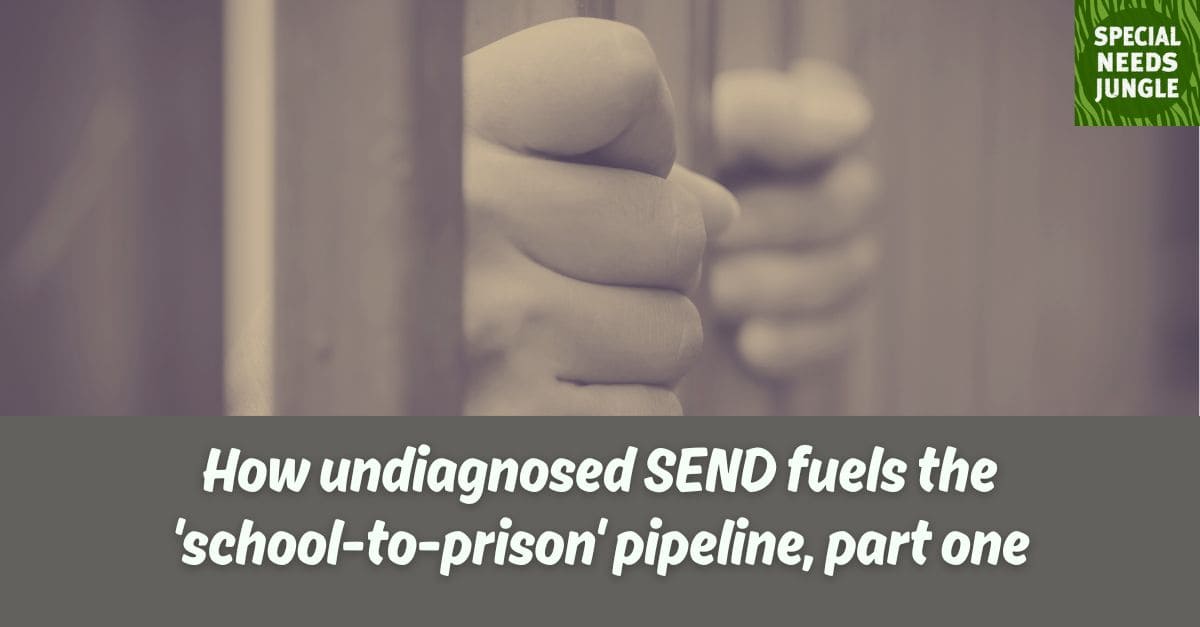
You may have heard of the school-to-prison pipeline, where often vulnerable teens have left, or been excluded from education, found themselves caught up in gangs and/or criminal activity, and ended up on the wrong side of a custodial sentence. Many of these young people are later found to have additional needs, particularly neurodiversity, as well as having experienced childhood trauma, homelessness, or are care-experienced.
Today we have the first of a two-part series from Dr Neil Alexander-Passe, focusing on the children who have been failed by the education system and have sought community elsewhere—often catastrophically so. The first article explains more about what the “school-to-prison pipeline” is and how it comes about. The second part will offer a copy of each of Neil’s books as a giveaway
What is the School-to-Prison Pipeline and how does it relate to young people with SEND? by Dr Neil Alexander-Passe
My interest in the ‘school-to-prison’ pipeline stems from my personal experience of being dyslexic and struggling at school. I was lucky to have found a passion and skills in art and design, and after leaving school with two ‘O’ Levels (art and religious studies), I went to art college for my first career as a graphic designer. I was aware that I could have easily fallen into the wrong crowd at school and given up academically, as I experienced failure in all areas of school.
Retraining as a teacher at the age of 40, I could see how easily students became disillusioned and how negative school behaviour policies discriminated against those who struggled to sit still or keep up with class learning, be it because of undiagnosed dyslexia, ADHD, or autism. Not much had changed from my own school days in the 1980s.
This is the first of two articles looking at the school-to-prison pipeline, following the publication of my two books, ‘Dyslexia, Neurodiversity, and Crime’ and ‘ADHD and Crime’. A third book, ‘Autism Awareness and Crime’ will be published in 2025. A copy of each book will be given away to Special Needs Jungle readers (in the second post—so sign up for new post alerts here or via WhatsApp!).
This first article will introduce the ‘school-to-prison’ pipeline with literacy /dyslexia, and the following one will go into more depth, looking at those with ADHD and Autism who fall into crime.
The school-to-prison pipeline
This “pipeline” is the understanding that what happens at school makes a huge difference to the success or failure of young people’s adult lives.
UK prison evidence suggests that 65% of all UK prisoners have a reading age of below 11 years old, with many lacking the ability to read and write. How can young people go through school without ending up with the ability to read and write? Understanding the reasons behind the pipeline will help readers see that, every year, given large class sizes and underfunded/under-resourced schools, young people can slip through the net and leave both primary and secondary school lacking such basic skills.
Research also suggests that up to 80% of those who might be diagnosed with dyslexia leave school without a diagnosis, and this can mean they see themselves as ‘thick’ and ‘stupid’. Not words they come to themselves, but are told to them by their teachers, parents, and class peers.
Education within prisons
Ofsted acknowledges the educational provision in UK prisons and Youth Offender Institutes is, in most cases, inadequate. While Ofsted’s former head, Amanda Spielman, highlighted that the ability to read opens a new world to prisoners, a world where they can find meaningful work and turn away from crime. However, prisons do not themselves teach the ability to read and write, relying on an external charity, The Shannon Trust, to train up peer mentors, other inmates, to offer such provision.
The UK government set prisoner educational targets to achieve Level 1 and 2 courses, and so provision is set up to achieve this; however, with an entry criterion of having to read and write, many prisoners are unable to join such courses. If probation and release are only offered to prisoners who have achieved Level 1 and 2 courses, and most prisoners struggle to fulfil such entry requirements, then many prisoners will lack the ability to gain release.
If they leave prison with the inability to read and find a job, then what rehabilitation has taken place?
Illiteracy has far-reaching disadvantages
Interestingly, while new prisoners are screened for literacy and helped, existing prisoners are not, meaning the true level of literacy in prisons is unknown. Many prisoners report they can’t read a menu, so they end up only eating sandwiches as they know the shape of that word. Illiteracy can mean they’re unable to see a doctor, apply for visitors, or buy a phone card to contact family, as they cannot complete paper forms. Many can’t read letters from their family or contact their lawyers if needed.
There is a potential question of injustice that prisoners who are illiterate or have limited literacy may have signed police statements they couldn’t have read or understood independently. Many with dyslexia who couldn’t account for their whereabouts when questioned by police may have been seen as guilty by default. Most take a ‘guilty plea’ to gain a reduced sentence, even if they are not guilty, as they don’t understand the criminal justice system.
This is an important topic for readers to be aware of, as we must act early in a child’s schooling to address such issues. As soon as a child struggles and is dismissed as ‘lazy or not trying’, rather than prompting a deeper look at barriers, they may begin to become disillusioned and turned off learning. That can be the start of the ‘school-to-prison’ pipeline. The Warnock Report (1978) suggested that one in five young people will struggle at some point in their school career; I believe this is a conservative figure. COVID highlighted to parents how their children struggle to sit down and learn, with a huge rise in referrals to CAMHS for possible ADHD and autism as a result.
Dyslexia and Crime
Schools value the ability to read, write, and spell above a child’s ability in drama, sports and creative subjects. Young people with language and dyslexic difficulties will struggle in all things valued highly by teachers. There is a point where they will struggle and ask for help, but when they see that help is not forthcoming, they will begin to develop coping strategies.
- avoidance is top of the list of strategies: constantly breaking pens/pencils so spending so much time sharpening them,
- asking to go to the toilet when it’s time for them to read aloud in class, or to start a test.
- Forgetting homework on purpose and hoping they don’t remember the next lesson to ask for it (in most cases, the teacher forgets)
- being the class clown, or doing something to be sent out of class.
- Avoiding the teacher’s eye radar at all costs. Many students disappear in class, only to emerge when the bell rings.
In secondary school, students are streamed to the lowest sets based on their written homework or tests, with no one asking themselves why they can talk about the subject orally, but struggle to put it down on paper. Dyslexia awareness is still poor in many schools, so labelling a young person as lazy or unintelligent without asking why places them in a position where they turn away from education and into an arena that values their abilities. Unfortunately, this comes in the form of external influences, not from parents who believe their child’s teachers, but from other disillusioned peers and potentially, the hands of gangs, drug culture, and crime.
What is happening in schools?
While you might assume schools have improved their SEND awareness, my own experience of 10 years as a SENDCO suggests otherwise. Class sizes of 30+ with a single teacher are extremely hard to manage. It’s often a case of survival for both the teacher and the student, with teachers resorting to inflexible school behavioural policies to cope. A struggling student is likely to display behavioural difficulties, and it’s easier to remove them than to ask why they’re being disruptive. In many cases, I find they can’t cope with the lesson or are unable to engage with the subject matter, which is commonly rushed through to fulfil the GCSE or SATs curriculum.
In Pupil Referral Units (PRUs) for both primary and secondary students, I know of many 7-8-year-olds sent there due to undiagnosed learning difficulties. I question if we really spend enough time understanding our young people before sending them away and labelling them ‘disruptive’.
UK data points to very high numbers of young people with EHCPs and undiagnosed SEND being sent to PRUS, suggesting it’s easier to remove than understand and support. This places vulnerable young people at risk, and being drawn into crime is sadly inevitable.
The next article will go into more depth with young people with ADHD and autism, plus a giveaway of four different books. Find it here
About the author

Dr Neil Alexander-Passe is a former school SENDCO, has worked in both primary and secondary sectors, in both state and independent sectors. He is currently an exam access assessor in a large 6th form college in central London.
He gained his PhD in 2018, researching ‘Dyslexia, School-based trauma, and Post-School Success’. He has published 13 peer-reviewed academic papers and 18 books on dyslexia, ADHD, and Autism. His research is trauma-informed and looks at how success and failure in those who have various special educational needs (SEND), mainly invisible differences.

Disabled Children’s Rights are Under Attack.
We’re fighting, but we can’t do it alone: we need your help more than ever.
We’re volunteer-run, but costs are rising. To help us keep going, please consider a one-off or, if it’s possible, a regular donation.
Read more about being a regular donor here.
We use Zeffy to fundraise, which doesn’t charge us a fee, so 100% of your donation reaches us.

Also read:
- Why legal aid may now be available for SEND families challenging school exclusions
- How our alternative provision schools manage zero exclusions: We never give up
- Too many children arrive in AP with no needs assessment—schools need to be more curious about the “why”
- Updated exclusions and behaviour guidance and how a thoughtful school culture can avoid discriminating against learners with SEND
- Exclusion must be a last resort says EHRC as they support a family to justice over their disabled child’s treatment
- School exclusion and the SEND proposals: Last chance to respond to the Government’s Call for Evidence on reforming exclusions

- Let’s scrutinise it: Why ministers should publish a draft SEND Bill now to enable Pre-Legislative Scrutiny
- What is the cost of an EHCP that isn’t delivered? And who’s responsible for checking it is?
- Book Review: Flush Forward! Rethinking Toileting for Disabled and Neurodivergent Young People
- Four real risks posed by plans to move away from child-centred SEND principles, towards NHS-style commissioning
- Early 2027 for Education and SEND Bill but how far will the Government row back on rights plans? Parental trust and confidence depend on it
- Locked out of holiday fun: SEND reform must tackle the provision gap for disabled children in care
- Training new teachers to arrive skilled, confident, and ready to support their pupils with SEND
- “We don’t see that here”: How teachers can better navigate a parent’s different view—and why pupil voice and professional curiosity are vital
- The AI-generated Local SEND Reform Plans that will dictate local SEND provision and their huge hidden risks even LAs can’t ignore
- The regional teams from Whole School SEND offering free SEND learning to school and college teaching staff
- Why ‘functioning’ might be the missing piece in the SEND reform puzzle






 What kind of government is “bold” enough to scrap statutory EHCPs from vulnerable children?May 16, 2025


 The SEND reforms in the Schools White Paper reveal rights given, and rights stripped awayFebruary 24, 2026


Don’t miss a thing!
Don’t miss any posts from SNJ – simply add your email address below. You must click the link in the confirmation email you’ll receive to activate your free subscription.
You can also keep up with us by following our
Want more? Be an SNJ regular donor!
SNJ is a non-profit and everyone who writes here does so voluntarily. We need your support to help us with costs by donating once or as a regular patron. Find out more here

- Let’s scrutinise it: Why ministers should publish a draft SEND Bill now to enable Pre-Legislative Scrutiny - November 17, 2026
- What is the cost of an EHCP that isn’t delivered? And who’s responsible for checking it is? - November 13, 2026
- Book Review: Flush Forward! Rethinking Toileting for Disabled and Neurodivergent Young People - November 11, 2026
Please share this article!

Discover more from Special Needs Jungle
Subscribe to get the latest posts sent to your email.

A most interesting and important article. I alerted Labour’s front bench to this issue in the early 1990s, and have also noted the tendency of people with literacy difficulties to find ways of expressing their abilities in fields that are not primarily dependent on it – a local watchmaker, two photographers (one of whom became an estate agent through his skills in photographing houses), and of course Jamie Oliver, are examples. I’ve ordered your book and would be grateful for access to your thesis, as the BL’s thesis library has not recovered from its destruction by scammers.