

By Emma McDonnell
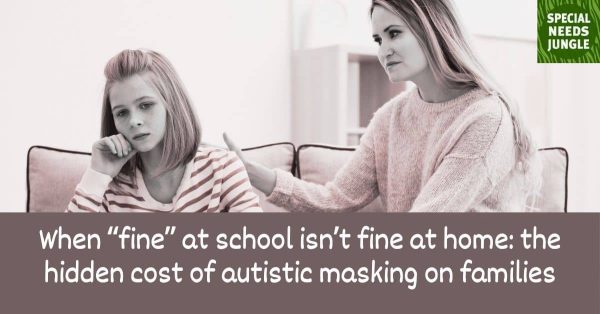
Emma McDonnell’s story is going to be familiar to many readers. “We don’t see that here,” or words to that effect, tell you they think you’re the problem. Your child is compliant and no problem at school, but once home—even before—they either meltdown, withdraw, or all hell breaks loose. Sometimes all three.
You begin to doubt yourself. Is it me? Am I a terrible parent? But you know, deep down, that your worries are justified. For many parents this is the start of a long battle—not even to get the SEND help you know your child needs, but to be believed to start off with.
Emma did what lots of us do; she educated herself. Researching, reading, developing her understanding of her child’s condition. It can simultaneously drive you onward and consume you as you search for answers to soothe your child’s suffering. And that’s before you enter the jungle to get support.
Here’s Emma to tell her story…
It often starts in the same way.
You collect your child from school. The teacher tells you they’ve had a good day. They’ve been calm, cooperative, even smiling. “No issues,” you’re told. And then, somewhere between the school gate and the car, everything unravels. The shouting. Crying. Climbing. Running. No awareness of danger. The overwhelm that seems to come from nowhere. Sometimes, before you’ve even turned the engine on.
If you live this, you already know what’s happening. But if you haven’t experienced it directly, it can look baffling. How can a child appear fine all day and then fall apart the moment they leave school?
This is what autistic masking can look like.
At school, a child may be suppressing anxiety, sensory overload, confusion, distress, and the constant effort of trying to fit in. They may be copying peers, watching the rules carefully, rehearsing what to say, hiding their discomfort, and doing everything they can not to draw attention to themselves. Some children fawn. Some become hyper-compliant. Some seem cheerful and sociable. Some go quiet and invisible. From the outside, it can look like coping. But often it is survival.
And then they come home. And the mask comes off.
The cost of holding it together
Masking is often described as a strategy. Sometimes conscious, sometimes not, used by autistic children to appear “fine” in environments that don’t feel safe. The National Autistic Society describes it as a way of appearing non-autistic in order to fit in, while the PDA Society describes it as suppressing needs, behaviours or distress in order to avoid detection or meet expectations. Camouflaging and masking are linked with poorer mental health outcomes, exhaustion, and a growing sense of disconnection from self.
But what gets missed far too often is this: masking does not remove a child’s needs. It hides them.
All of that effort builds across the day. The sensory load. The social effort. The anxiety. The self-suppression. Many parents describe it like a fizzy drink bottle that has been shaken all day. By the time the child gets home and the lid comes off, everything explodes.
That was certainly our experience. When we were still early in our journey, I was desperately trying to get school to understand that just because my child looked compliant, smiling and settled in class, it did not mean they were coping. The moment I picked them up, the mask slipped. Sometimes before we even reached the car, they were already unravelling – shouting, climbing, lashing out, completely overwhelmed by the release of a day’s worth of effort. None of that ever showed up in school. At school, they did everything they could to fit in. They copied. They fawned. They people-pleased. They worked incredibly hard not to appear different.
It was exhausting for them. And in turn, it was exhausting for us at home.
Over time, for some children, that effort becomes unsustainable. The mask gets harder and harder to hold in place. You may start to see increased anxiety around school, more resistance in the mornings, more frequent calls to collect early, or a child who simply cannot go in at all because the cost of masking has become too high. That unpredictability adds another layer for parents. You cannot rely on the day going as planned. Work becomes difficult to sustain. Plans become tentative at best. You are constantly adapting around what your child can manage that day.
The load that moves home
This is the part I don’t think we talk about enough. When a child masks at school, the regulatory load does not disappear; it shifts.
What looks like a “good day” at school can translate into an incredibly difficult evening at home. Parents are left holding the fallout—co-regulating intense emotions, managing explosive behaviour, absorbing distress that has been bottled up all day, and trying to make sense of something that often bears no resemblance to what school staff have seen.
All this changes family life in ways that it’s often hard for people outside it to grasp.
You can’t just pop to the shops on the way home. You can’t assume you’ll be able to get dinner on the table in the usual way. You may not be able to do clubs, appointments, homework, or ordinary after-school routines. The whole evening becomes about de-escalation. About getting your child through the release of everything they have been holding in. Life starts to shrink around that reality.
For us, there were times when home did not feel like home in the way people imagine. It became the place where everything was released. Sometimes that looked like explosive behaviour—shouting, throwing, lashing out, climbing, complete overwhelm. Sometimes it looked like the opposite—zoning out, shutting down, disappearing into screens, needing to withdraw completely. Often it moved between the two, which left us constantly adjusting and never quite sure what we were dealing with.
We tried everything we could think of to support regulation. Outside space, movement, therapy balls, weighted blankets, proprioceptive input, deep pressure, sensory strategies. Sometimes those things helped. Sometimes they didn’t. Because once a child is already highly escalated, they are not always able to access the very things that might support them.
So you find yourself walking on eggshells, trying to hold the space, trying to keep everyone safe, trying to bring the intensity down without pushing too hard or making things worse.
Living in hypervigilance
Over time, that does something to you.
Hypervigilance is the word I keep coming back to, because it explains so much. It is not just stress. It is not just being tired. It is a nervous system that no longer knows how to switch off.
You are always scanning. Anticipating. Reading the room. Listening out. Thinking three steps ahead. You are watching your child’s face, their tone, the pace of their movements, the sensory environment, the time of day, the demands building, the sibling dynamic, the school messages, the knock-on effect of one small change. Even when things look calm on the surface, your body is still braced, because experience has taught you that calm can disappear in a second.
This is what so many parents are living with. You wake up tired. You are already in motion before the day has properly started. You are trying to get your child out of the door while they’re anxious, overwhelmed, or struggling to cope. You’re holding everything together – bags, packed lunches, forms, emails, remembering what’s needed, trying not to forget anything important – all while staying calm enough to co-regulate. Even when things go relatively smoothly, your body does not relax. It is waiting for the next thing.
That is the inner world of hypervigilance. It is being on call 24/7. It is never quite exhaling. It is telling yourself, “I’ll relax after this next thing,” and then discovering there is always another thing.
The stress test
Sustained exposure to this level of unpredictability and emotional demand keeps a parent’s nervous system in a prolonged state of threat response. Masking and camouflaging are widely understood to be exhausting, often placing significant emotional strain on autistic individuals and their families, with parents reporting the impact of this strain at home (Mullally & Connolly, 2025). Studies also show that parents of children experiencing school distress report significantly increased stress, anxiety, and wider impacts on family life, including work, finances, and relationships (Mullally & Connolly, 2025).
Research exploring the experiences of families of children with a PDA profile also highlights a lack of understanding, blame, and insufficient support from services, alongside significant emotional impact across the whole family (Nawaz & Speer, 2025).
Parents are often stretched far beyond capacity – emotionally, physically and financially. Work becomes difficult or impossible to sustain because you never quite know what the day will bring. For many families, one parent ends up stepping back from their career or reducing hours to absorb more of the emotional and practical load, while the financial pressure shifts more heavily onto the other. That imbalance, combined with exhaustion, stress, and the intensity of day-to-day life, can place huge strain on relationships.
The impact on the whole family
This doesn’t just affect one child and one parent. It affects entire families. It’s like living in a pressure cooker: High stress. Unpredictability. Explosive behaviour. Guilt. Blame. Sometimes, disagreement on how to handle it all.
And then there are siblings.
Siblings who witness the meltdowns, the volatility, the constant attention required. Siblings who, in many cases, learn to make themselves smaller. Quieter. Easier. Not because they don’t have needs of their own, but because they can see how much is already being carried.
They don’t want to be the problem too.
So they hold things in. They manage themselves. They don’t ask for help. And as a parent, you see it. You feel it. You feel pulled in two directions at once, trying to meet the needs of a child in distress while also knowing another child is quietly putting their own needs aside.
In some families, there are real concerns around physical safety during moments of extreme dysregulation. This is something many parents live with but rarely feel able to talk about openly, for fear of judgment or misunderstanding. So they manage it quietly. Separating children. Staying hyper-aware. Holding everything together behind closed doors.
The emotional weight of that is enormous. The Cerebra report on systems-generated trauma highlights the wider impact on families, including siblings experiencing distress from ongoing crises and systemic failures (Cerebra, 2025).
The systems that add to the strain
And this is where the wider systems have to be named, because they are a big part of the problem, often making a difficult situation much worse.
For many families, the hypervigilance does not centre only around the child. It extends to the systems around them. School, attendance local authority processes, assessments, waiting lists. Professionals who do not understand masking. The fear of being blamed. The fear of not being believed.
The systems-generated trauma, where interactions with education, health, and social care services create additional harm. Parents report being disbelieved, threatened over attendance, or made to feel responsible for needs that are not being adequately supported. That constant pressure sits alongside everything happening at home. It adds another layer of stress, another reason your nervous system cannot settle.
A place to start: lowering expectations
If you recognise yourself in this, you are not imagining it, and you’re not alone. We all know there is no quick fix for this kind of life. Most parents reading this already know that the support we need often isn’t there, or is incredibly hard to access. We spend so much of our energy fighting for our children, that there’s very little left for ourselves.
But even within that, small shifts can make a difference. Not in a way that fixes everything, but in a way that helps things feel just a little more manageable. Here are a few that may seem small, but you may well recognise how hard you are on yourself:
- Allow yourself to lower your expectations on what a “good day” looks like.
- Allow yourself to lett go of the idea that you should be able to do everything.
- Notice the way you speak to yourself and soften it, even slightly.
- Allow yourself to pause for a moment without feeling guilty.
- Allow yourself to believe that the way you feel is not a personal failure, but a response to prolonged stress.
You don’t need hours of free time or perfect conditions for this. Most parents don’t have that. It is about small, realistic adjustments that help your nervous system feel just a fraction safer. A fraction calmer. Just enough to keep going.
Because this isn’t about putting your needs ahead of your child’s. It’s about learning to meet your own needs alongside theirs. And that matters.
About the author

Emma McDonnell is a parent-carer, neurodivergent mum, and someone who understands the relentlessness of supporting neurodivergent children in a world that doesn’t always understand. She has lived the reality of navigating EHCPs, managing explosive behaviours, and the emotional toll of masking – when a child seems “fine” at school but unravels at home.
Alongside her ongoing journey with her own family, Emma now supports other parents to feel less alone in the chronic stress and hypervigilance that often comes with this life, helping them build small, realistic ways to feel calmer and more grounded before reaching burnout.
Emma shares a small collection of free resources for parents living this reality here https://emma-mcdonnell.com/freebies
Sources Referenced
- Clements, L. and Aiello, A. L. (2025). Systems Generated Trauma: How disabled children and their families are traumatised by dysfunctional public services when they ask for support. Cerebra. See SNJ’s article
- Mullally, S. L. and Connolly, S. E. (2025). “I felt shamed and blamed”: an exploration of the parental lived experience of school distress. Frontiers in Psychiatry, 16, 1489316.
- Nawaz, S. and Speer, S. (2025). What are the experiences and support needs of families of autistic children with Extreme (or ‘Pathological’) Demand Avoidance (E/PDA) behaviours? Research in Autism Spectrum Disorders.
- The National Autistic Society – Masking
- The PDA Society – What PDA can look like in education settings
Disabled Children’s Rights are Under Attack.
We’re fighting, but we can’t do it alone: we need your help more than ever.
We’re volunteer-run, but costs are rising. To help us keep going, please consider a one-off or, if it’s possible, a regular donation.
Read more about being a regular donor here.
We use Zeffy to fundraise, which doesn’t charge us a fee, so 100% of your donation reaches us.

Also read:
- The regional teams from Whole School SEND offering free SEND learning to school and college teaching staff

- Why ‘functioning’ might be the missing piece in the SEND reform puzzle
- The child behind the symptoms: Why MCAS is being missed in children and young people
- The government must not ignore stark warnings about lack of mainstream SEND capacity reported by its own research
- What makes an autism assessment report genuinely useful to a school?
- Big ideas belong to everyone: Education, rights and lifelong learning for people with learning disabilities
- As The Guardian prints our joint campaign’s open letter, it’s clear people with lived experience don’t want to lose SEND rights
- How do you ensure pathways to education, health, and social care support, meet both diagnosis and needs?
- Researching flexi-schooling: How beneficial is it for children with SEND?
- Oops, we did it again… The Government must now listen to more than 100,000 people who do not want to lose SEND rights
- Experts at Hand: When is an occupational therapist also a SEND expert?
- Could using AI to filter Government consultation responses lead to “algorithmic silencing” of neurodivergent voices?






- The child behind the symptoms: Why MCAS is being missed in children and young people
- What makes an autism assessment report genuinely useful to a school?
- How do you ensure pathways to education, health, and social care support, meet both diagnosis and needs?
- Researching flexi-schooling: How beneficial is it for children with SEND?
- Could using AI to filter Government consultation responses lead to “algorithmic silencing” of neurodivergent voices?
- How health and family support systems are failing children starting school
- From suspicion to support: why the Government’s child protection reforms matter for disabled children
- Home education: Five practical tips to create a neuro-affirming Unschooling environment* GIVEAWAY!
- How Twinkl Parents are aiming to give SEND families a voice—and some free resources
- When “fine” at school isn’t fine at home: the hidden cost of autistic masking on families
- SEND reforms and the forgotten children at risk of exclusion
- Research: Inclusion for neurodivergent pupils needs lived-experience trainers and getting the wider school environment right
- Why my daughter’s SEND experience means we’ll take this consultation judicial review fight wherever it needs to go
- “Why would anyone in government think that was an okay idea?” #SaveSENDLegalRights
- ARFID: Avoidant/Restrictive Food Intake Disorder is much more than just “fussy eating”


 What kind of government is “bold” enough to scrap statutory EHCPs from vulnerable children?May 16, 2025


 The SEND reforms in the Schools White Paper reveal rights given, and rights stripped awayFebruary 24, 2026


Don’t miss a thing!
Don’t miss any posts from SNJ – simply add your email address below. You must click the link in the confirmation email you’ll receive to activate your free subscription.
You can also keep up with us by following our
Want more? Be an SNJ regular donor!
SNJ is a non-profit and everyone who writes here does so voluntarily. We need your support to help us with costs by donating once or as a regular patron. Find out more here

- The regional teams from Whole School SEND offering free SEND learning to school and college teaching staff - October 23, 2026
- What makes an autism assessment report genuinely useful to a school? - October 14, 2026
- Big ideas belong to everyone: Education, rights and lifelong learning for people with learning disabilities - October 12, 2026
Please share this article!

Discover more from Special Needs Jungle
Subscribe to get the latest posts sent to your email.
